Let ReSharper and Code Contracts work together
How to make ReSharper understand .NET Code Contracts such as Contract.Requires by extending its external annotations and eliminating false nullability warnings.
ReSharper by default does not recognize Contract.Requires as an annotation hint, that the proofed condition furthermore is true.
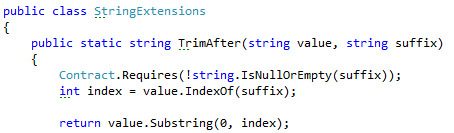
So it comes to the effect, that using the following contract definition causes ReSharper to squiggle the next access and output a wrong hint:

To suppress this behavior ReSharper needs additional external annotations information.
I followed in some points this thread:
ReSharper - Possible Null Assignment when using Microsoft.Contracts
I extended the existing mscorlib.4.0.0.0.Contracts.xml – not like described the mscorlib.xml (this has not worked at my machine) – with the stated information:
<assembly name="mscorlib">
    <member name="M:System.Diagnostics.Contracts.Contract.Assert(System.Boolean)">
        <attribute ctor="M:JetBrains.Annotations.AssertionMethodAttribute.#ctor"/>
        <parameter name="condition">
            <attribute ctor="M:JetBrains.Annotations.AssertionConditionAttribute.#ctor(JetBrains.Annotations.AssertionConditionType)">
                <argument>0</argument>
            </attribute>
        </parameter>
    </member>

    <member name="M:System.Diagnostics.Contracts.Contract.Assert(System.Boolean, System.String)">
        <attribute ctor="M:JetBrains.Annotations.AssertionMethodAttribute.#ctor"/>
        <parameter name="condition">
            <attribute ctor="M:JetBrains.Annotations.AssertionConditionAttribute.#ctor(JetBrains.Annotations.AssertionConditionType)">
                <argument>0</argument>
            </attribute>
        </parameter>
    </member>

    <member name="M:System.Diagnostics.Contracts.Contract.Assume(System.Boolean)">
        <attribute ctor="M:JetBrains.Annotations.AssertionMethodAttribute.#ctor"/>
        <parameter name="condition">
            <attribute ctor="M:JetBrains.Annotations.AssertionConditionAttribute.#ctor(JetBrains.Annotations.AssertionConditionType)">
                <argument>0</argument>
            </attribute>
        </parameter>
    </member>

    <member name="M:System.Diagnostics.Contracts.Contract.Assume(System.Boolean, System.String)">
        <attribute ctor="M:JetBrains.Annotations.AssertionMethodAttribute.#ctor"/>
        <parameter name="condition">
            <attribute ctor="M:JetBrains.Annotations.AssertionConditionAttribute.#ctor(JetBrains.Annotations.AssertionConditionType)">
                <argument>0</argument>
            </attribute>
        </parameter>
    </member>

    <member name="M:System.Diagnostics.Contracts.Contract.Requires(System.Boolean)">
        <attribute ctor="M:JetBrains.Annotations.AssertionMethodAttribute.#ctor"/>
        <parameter name="condition">
            <attribute ctor="M:JetBrains.Annotations.AssertionConditionAttribute.#ctor(JetBrains.Annotations.AssertionConditionType)">
                <argument>0</argument>
            </attribute>
        </parameter>
    </member>

    <member name="M:System.Diagnostics.Contracts.Contract.Requires``1(System.Boolean)">
        <attribute ctor="M:JetBrains.Annotations.AssertionMethodAttribute.#ctor"/>
        <parameter name="condition">
            <attribute ctor="M:JetBrains.Annotations.AssertionConditionAttribute.#ctor(JetBrains.Annotations.AssertionConditionType)">
                <argument>0</argument>
            </attribute>
        </parameter>
    </member>

    <member name="M:System.Diagnostics.Contracts.Contract.Requires(System.Boolean,System.String)">
        <attribute ctor="M:JetBrains.Annotations.AssertionMethodAttribute.#ctor"/>
        <parameter name="condition">
            <attribute ctor="M:JetBrains.Annotations.AssertionConditionAttribute.#ctor(JetBrains.Annotations.AssertionConditionType)">
                <argument>0</argument>
            </attribute>
        </parameter>
    </member>

    <member name="M:System.Diagnostics.Contracts.Contract.Requires``1(System.Boolean,System.String)">
        <attribute ctor="M:JetBrains.Annotations.AssertionMethodAttribute.#ctor"/>
        <parameter name="condition">
            <attribute ctor="M:JetBrains.Annotations.AssertionConditionAttribute.#ctor(JetBrains.Annotations.AssertionConditionType)">
                <argument>0</argument>
            </attribute>
        </parameter>
    </member>

    <member name="M:System.Diagnostics.Contracts.Contract.Invariant(System.Boolean)">
        <attribute ctor="M:JetBrains.Annotations.AssertionMethodAttribute.#ctor"/>
        <parameter name="condition">
            <attribute ctor="M:JetBrains.Annotations.AssertionConditionAttribute.#ctor(JetBrains.Annotations.AssertionConditionType)">
                <argument>0</argument>
            </attribute>
        </parameter>
    </member>

    <member name="M:System.Diagnostics.Contracts.Contract.Invariant(System.Boolean,System.String)">
        <attribute ctor="M:JetBrains.Annotations.AssertionMethodAttribute.#ctor"/>
        <parameter name="condition">
            <attribute ctor="M:JetBrains.Annotations.AssertionConditionAttribute.#ctor(JetBrains.Annotations.AssertionConditionType)">
                <argument>0</argument>
            </attribute>
        </parameter>
    </member>
</assembly>
The opening and closing <assembly>-tags are only for orientation. You must use the existing tags, so copy only the inner part – all stuff with <member>-tags.
Maybe you get permission-problems by saving the edited file. As a simple workaround you move the file to another directory with more permissions, edit the file there and move it back. These I/O-operations could be made with elevating – windows ask you automatically for the credentials with more rights.
After that you must reload the solution. Yes, a simple reload is enough – you don’t need to close and restart Visual Studio.
Then the written lines don’t have squigglies: